
Furnace Size Calculator
An oversized furnace short-cycles, wastes fuel and leaves rooms uneven; an undersized one can’t keep up on the coldest days. This calculator estimates the heat your home needs two ways — a quick climate-zone rule of thumb and a fuel-use method based on your actual gas bills — then converts it to the furnace input size to shop for.
- Free to use
- No sign-up
- Runs in your browser
Furnace size calculator
Quick estimate: area and climate
Better estimate: from last winter’s gas use
Furnace Sizing Template Pack
Room-by-room heat load worksheet, fuel-use sizing worksheet, furnace quote comparison sheet, seasonal maintenance checklist and contractor questions.
- Heat load worksheet (XLSX)
- Fuel-use worksheet (XLSX)
- Quote comparison (PDF/DOCX/XLSX)
- Maintenance checklist (PDF/DOCX)
- Contractor questions (PDF/DOCX)
Formats: XLSX, PDF, DOCX. Instant download after payment (link valid 72 hours, up to 5 downloads). AI-assisted: the templates were drafted with AI help and reviewed and laid out before publishing.
$5.00 USD, one-time 5 files · about $1.00 each
- Instant download
- 7-day refund
- Secure checkout by Stripe
7-day money-back guarantee. Full refund within 7 days of purchase, even after you download.
Free sample: Room Heat Load Worksheet (PDF, 54 KB)
Full refund within 7 days — see the refund policy and license.
Free printables
Single sheets you can print right now, no sign-up. The full pack adds every sheet in one download plus the editable files.
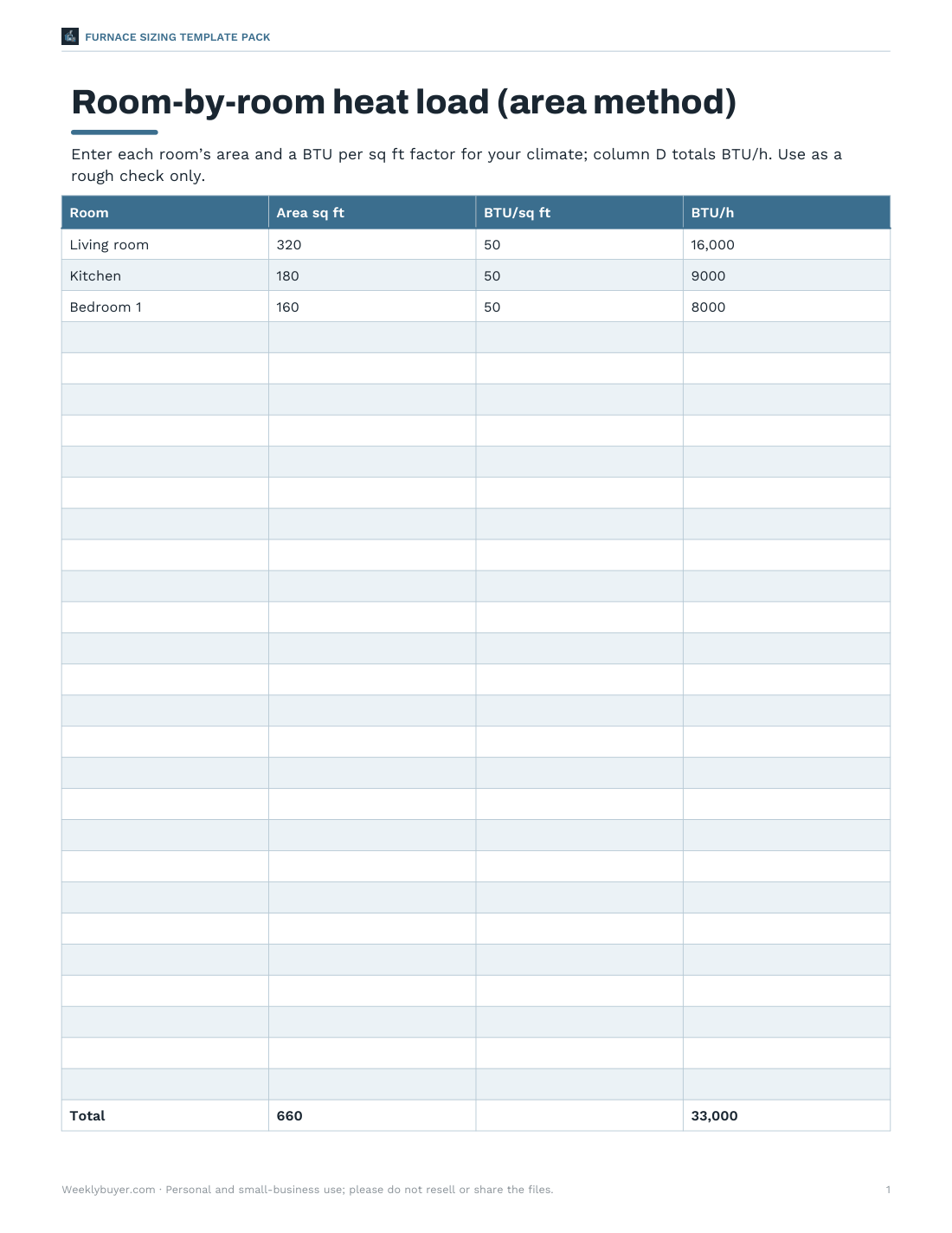
 Printable Furnace Heat Load Worksheet
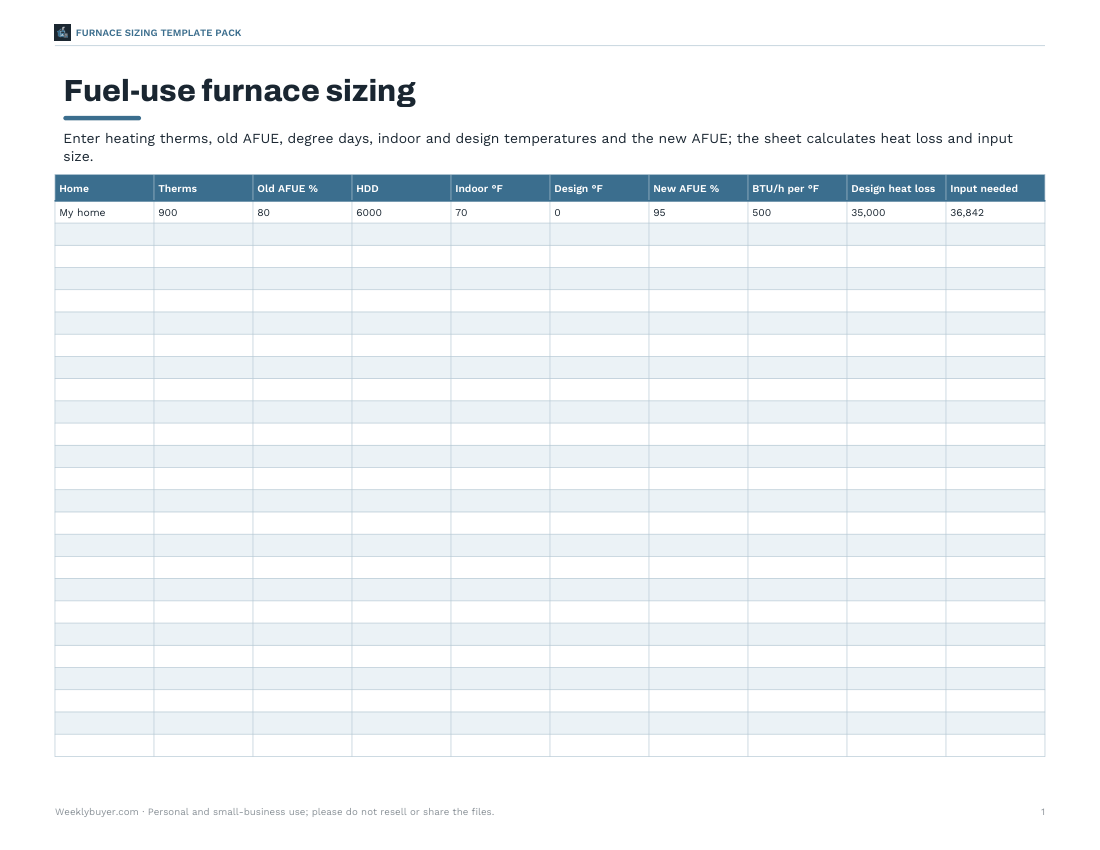
 Furnace Fuel-Use Sizing Worksheet
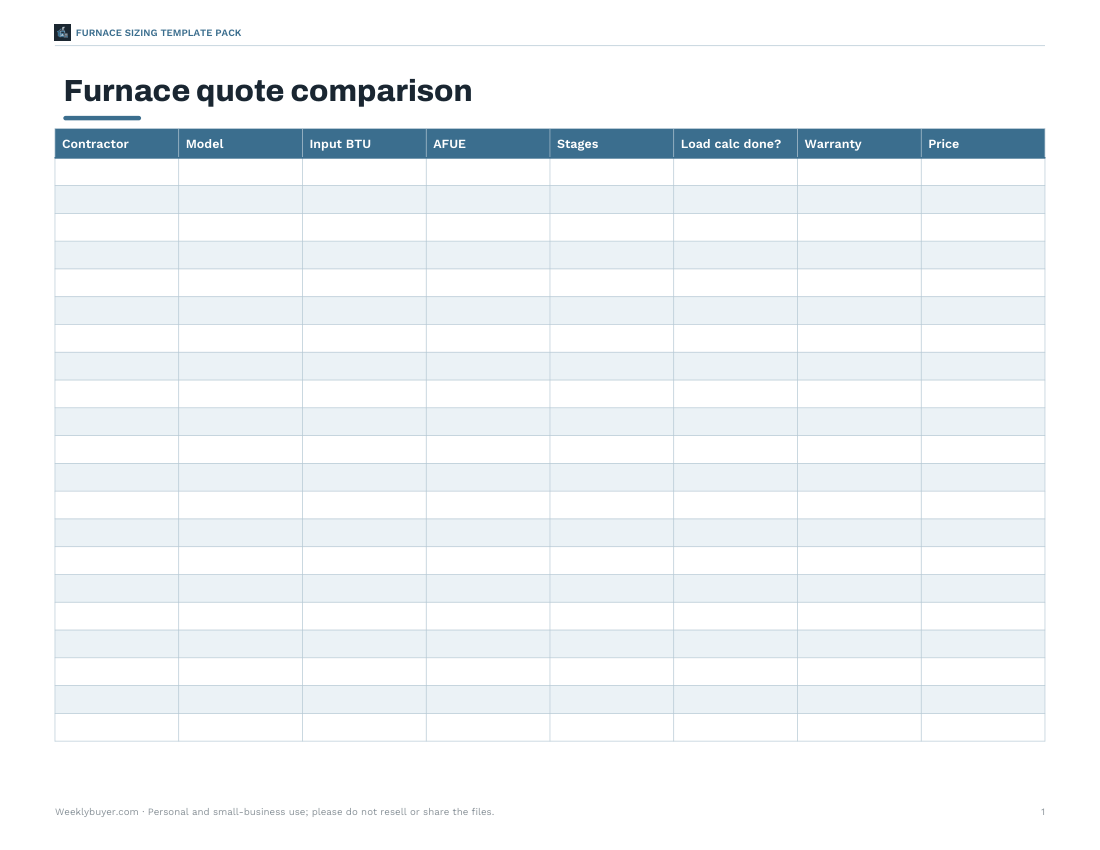
 Furnace Quote Comparison Sheet
 Printable Furnace Maintenance Checklist
 Printable Contractor Questions Sheet
Two ways to estimate furnace size
| Method | Inputs | Accuracy |
|---|---|---|
| Square feet × BTU per sq ft | Floor area, climate, insulation | Rough — easy but can be far off |
| Fuel-use method | Last winter’s gas use, degree days, old furnace efficiency | Good for an existing home — reflects how it really performs |
| Manual J load calculation | Room-by-room walls, windows, insulation, air leakage, orientation | The industry standard for sizing HVAC equipment |
Rules of thumb tend to oversize furnaces. Many homes, especially after insulation and window upgrades, need less capacity than the furnace they have.
BTU per square foot by climate
| Climate | BTU/h per sq ft | 2,000 sq ft home |
|---|---|---|
| Zone 1 (hot: e.g. south Florida, Hawaii) | 30–35 | 60,000–70,000 BTU/h |
| Zone 2 (warm: Gulf Coast, south Texas) | 35–40 | 70,000–80,000 BTU/h |
| Zone 3 (mild: Southeast, southern Plains) | 40–45 | 80,000–90,000 BTU/h |
| Zone 4 (mixed: Mid-Atlantic, Midwest south) | 45–50 | 90,000–100,000 BTU/h |
| Zone 5 (cold: Northeast, northern Midwest) | 50–60 | 100,000–120,000 BTU/h |
| Zone 6–7 (very cold: northern border states, mountains) | 60–70 | 120,000–140,000 BTU/h |
These ranges are common rules of thumb for an average home with 8-foot ceilings; they are not a substitute for a load calculation.
The fuel-use method
- Add up the gas used for heating over a season, in therms (subtract water heating and cooking).
- Multiply by 100,000 BTU per therm and by the old furnace’s efficiency to get the heat actually delivered.
- Divide by the season’s heating degree days × 24 to get the home’s heat loss per °F.
- Multiply by the difference between your indoor temperature and your area’s winter design temperature.
- Divide by the new furnace’s AFUE to get the input rating.
Example: 900 therms at 80% AFUE over 6,000 degree days gives 900 × 100,000 × 0.8 ÷ (6,000 × 24) = 500 BTU/h per °F. At a 70 °F indoor and 0 °F design temperature, the design heat loss is about 35,000 BTU/h — so a 95% furnace needs about 36,842 BTU/h input — a 40,000 BTU model would cover it.
Worked example
A 2,000 sq ft home in climate zone 5 with average insulation: the quick method gives 100,000–120,000 BTU/h of heat loss — suggesting a 120,000–140,000 BTU input furnace at 95% efficiency. The same home’s gas bills tell a different story: the fuel-use method puts its design heat loss near 35,000 BTU/h, so a 40,000 BTU input furnace would be enough. That gap is typical, and it’s why rules of thumb shouldn’t be the only basis for buying equipment.
Input vs output and AFUE
Furnaces are labelled by input — the fuel burned per hour. Output (the heat delivered to the house) is input × efficiency. An 80,000 BTU input furnace at 80% AFUE delivers about 64,000 BTU/h; the same input at 96% delivers about 76,800 BTU/h. AFUE (annual fuel utilisation efficiency) is measured under standard seasonal conditions. Many high-efficiency furnaces also have two-stage or modulating burners that run at lower output most of the time, which improves comfort.
Why oversizing is a problem
- Short cycling: the furnace heats quickly and shuts off, wearing parts and wasting fuel.
- Uneven temperatures and more noticeable temperature swings.
- Larger furnaces may need larger ducts than the house has, causing noise.
- Higher upfront cost for capacity you rarely use.
- A modest safety margin is fine; doubling the calculated load is not.
What’s in the template pack
- Room-by-room heat load worksheet (area method) in Excel
- Fuel-use sizing worksheet with degree-day formula
- Furnace quote comparison sheet (size, AFUE, stages, warranty, price)
- Seasonal furnace maintenance checklist
- Questions to ask HVAC contractors
The pack is a one-time download; the calculator is free.
Frequently asked questions
What size furnace do I need for 2,000 sq ft?
Rules of thumb suggest roughly 60,000–140,000 BTU/h of heat loss depending on climate; a load calculation gives the real answer.
What is a heating degree day?
A measure of how cold a period was: each day contributes 65 °F minus the average temperature, if positive.
Is a bigger furnace better?
No — oversized furnaces short-cycle and can be less comfortable.
What does 80% AFUE mean?
About 80% of the fuel’s energy becomes heat for the home over a season.
What is Manual J?
The ACCA standard method for calculating a home’s heating and cooling loads.
Where do I find my gas use?
On your utility bills or online account, usually in therms or cubic feet.
What is a design temperature?
The cold outdoor temperature a heating system is sized for — for example, the temperature exceeded 99% of the hours in a typical winter.
Can I size a heat pump this way?
The heat loss estimate applies, but heat pump capacity drops in cold weather, so check capacity at your design temperature.
Does adding insulation change furnace size?
Yes — better insulation and air sealing lower the heat loss and can allow a smaller furnace.